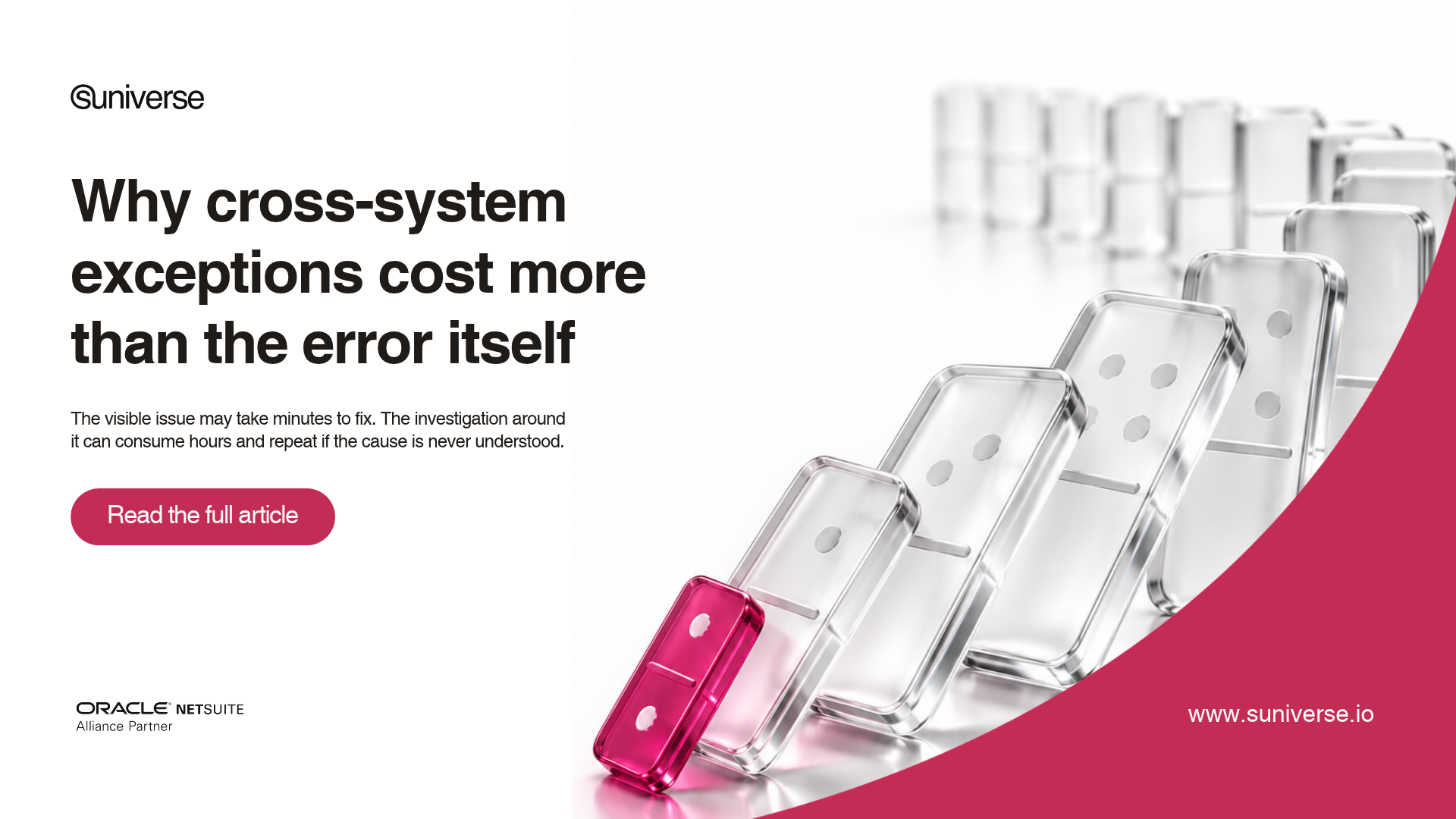
The visible issue maytake minutes to fix. The investigation around it can consume hours - and repeatif the business never learns why the problem happened.
The error is often the smallest part of the work
An order ships but the payment is never captured. Aninventory balance does not match. An invoice disagrees with the transactionupstream. A customer case cannot be resolved without checking severaldepartments.
The visible problem may be simple to describe. The workrequired to understand it often is not.
Someone checks the ERP. Another person looks at the paymentplatform. Operations reviews fulfillment. Support searches the customerhistory. IT checks the integration log. Then the team tries to reconstruct whathappened in the right order.
By the time the correction is made, the company may havespent far more effort investigating the exception than fixing it.
Cross-system problems create hidden investigation cost
Many operating processes now cross several applicationsbefore the work is complete.
An order can begin in ecommerce, move into ERP, trigger apayment event, create a fulfillment request, generate a shipment, andeventually affect finance and customer support.
When one part of that chain does not agree with another, theproblem does not belong to a single system anymore.
The investigation cost comes from rebuilding the context:which record is authoritative, what changed first, which event failed, whatbusiness rule should have applied, who owns the decision, and whether theproposed action is safe.
The same investigation is often repeated
The cost grows when the exception is recurring.
A team may resolve the immediate issue but preserve verylittle of the reasoning behind the resolution. The ticket closes. The record iscorrected. The next time the same condition appears, another team starts theinvestigation again.
That repeated searching is operational waste, but it is alsolost organizational memory.
A stronger resolution process should preserve enough of thecase that the business can recognize patterns, improve rules, and avoidrediscovering the same answer.
Evidence should come before action
AI makes it possible to search, compare, and summarizeinformation across systems more quickly.
That does not mean the system should jump directly fromdetection to action.
For operational problems, the evidence matters. Whichrecords support the explanation? Which event changed the state? Which source isauthoritative? What uncertainty remains?
A useful investigation makes that evidence visible enoughfor the business to understand why a particular action is being recommended.
Probable cause is not the same as certainty
Real operating environments are messy. Sometimes theavailable evidence supports a probable cause rather than an absolute one.
That distinction should be explicit.
If the evidence is weak, the workflow should know when toask for more information, route the case to a person, or stop before anirreversible action is taken.
Confidence is not simply a model property. It is part of theoperating decision about what happens next.
Control should match the consequence of the action
Reading records, recommending a resolution, approving afinancial action, changing a transaction, and verifying the result aredifferent levels of authority.
They should not automatically receive the same permissions.
A business may allow AI to investigate broadly acrossconnected systems while requiring a named person to approve customer,financial, inventory, or production-impacting changes.
This separation makes automation more practical because thecontrol is designed into the resolution path.
Verification is what turns a correction into a resolution
One of the easiest mistakes in automation is treatingsuccessful execution as successful resolution.
If a payment is retried, did it actually capture? Ifinventory is adjusted, do the relevant systems agree now? If an integration isre-run, did the downstream record reach the expected state?
Verification asks the original question again after theaction.
Is the condition that started the investigation actuallygone?
That step closes the loop.
A resolution record creates operational memory
A structured case record can preserve what was found, whichevidence mattered, what cause was identified, which action was recommended, whoapproved it, what changed, and whether the result was verified.
Over time, those records become more than audit history.
They create a library of real operating cases that canimprove policies, help teams recognize recurring causes, and provide betterexamples for evaluating future automation.
The goal is fewer repeated investigations
Faster resolution is useful, but speed should not be theonly measure.
A stronger question is whether the business is gettingbetter at understanding why exceptions occur and preventing the sameinvestigative work from repeating.
That is the thinking behind Solution IQ: connect theevidence, reason over the actual operating context, keep sensitive actionscontrolled, and verify the outcome.
For teams exploring this problem space, the useful startingpoint is not a product demo. It is identifying the recurring investigationsthat consume the most cross-functional time today.
Learn more about the operating model behind Solution IQ athttps://suniverse.io/solution-iq.
Sources& Further Reading
Microsoft Research - The Art of Building Verifiers forComputer Use Agents