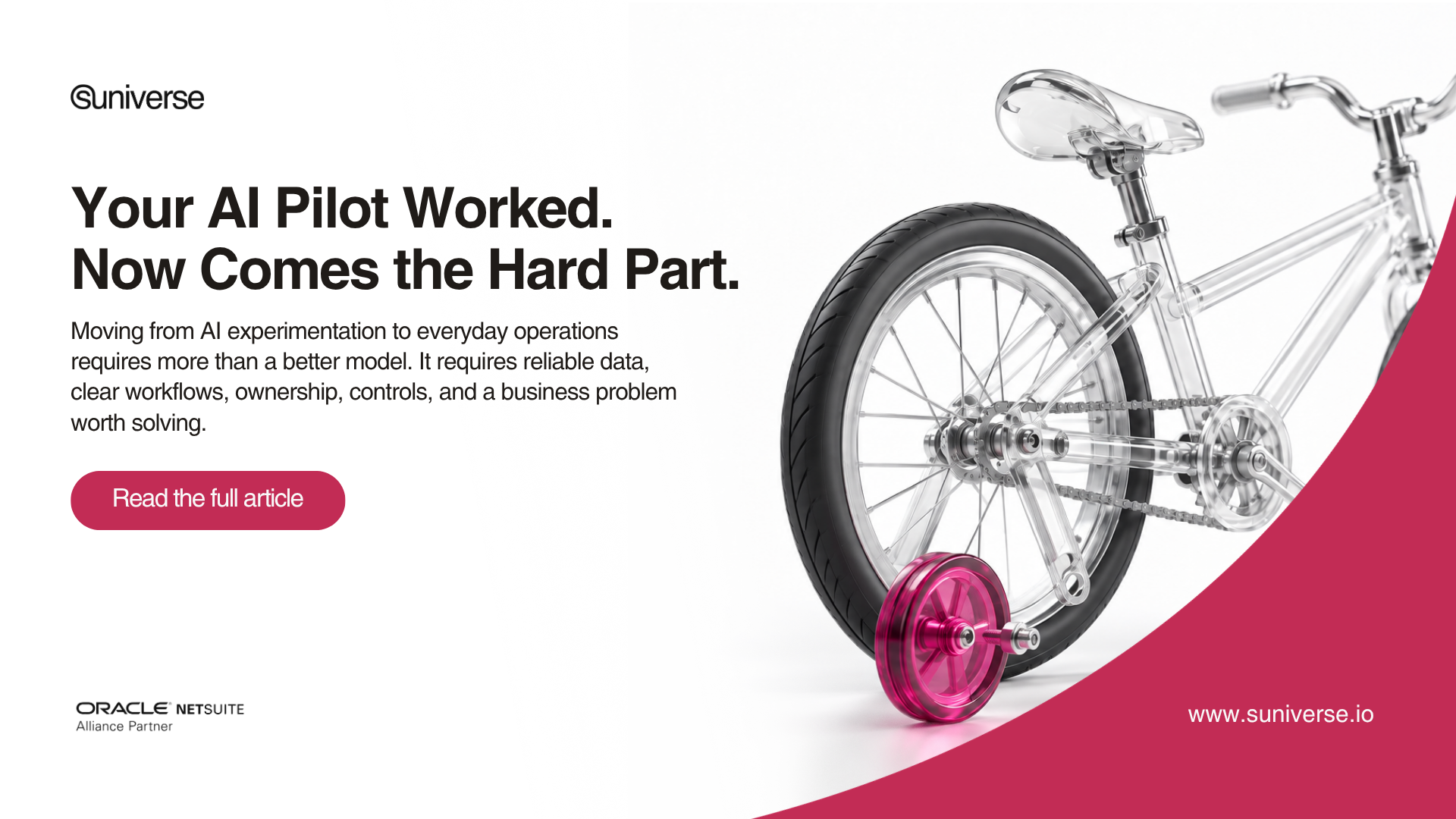
The demo is no longer the difficult part
Enterprise AI has crossed an important threshold. For many organizations, proving that AI can do something useful is no longer the hardest part. Teams can summarize documents, draft responses, analyze records, build assistants, and automate narrow tasks faster than they could even a year ago.
The difficult part begins after the demonstration works. A capability that performs well in a controlled pilot still has to operate inside a real business: across finance, operations, ERP, CRM, email, documents, approvals, exceptions, permissions, and people with different responsibilities.
That is the gap many organizations are now confronting. Deloitte's 2026 State of AI in the Enterprise research puts the move from pilot to scale at the center of the enterprise AI conversation. The question is shifting from “Can we build this?” to “Can we operate this reliably, repeatedly, and with measurable value?”
Those are very different questions.
1. Start with a business problem worth solving
The strongest AI initiatives usually begin with friction, not technology.
A process takes too long. A team spends hours reconciling information. A decision depends on searching across multiple systems. Exceptions are discovered late. Status updates are assembled manually. Knowledge lives with a few people instead of inside a repeatable process.
These are useful starting points because the business problem already has a cost, an owner, and an observable outcome. AI becomes one possible way to improve the work rather than the reason for the project to exist.
A practical test is simple: if the AI tool disappeared from the proposal, would the underlying problem still be worth fixing? If the answer is no, the initiative may be more about experimentation than operating value.
That does not make experimentation bad. It simply means experiments and production systems should be judged differently.
2. Give AI data it can actually trust
AI can produce a confident answer from weak information. That is precisely why data readiness matters.
Consider the data problems that already exist inside mature businesses: duplicate customer records, inconsistent product names, outdated classifications, conflicting definitions of margin, spreadsheets that have quietly become systems of record, or documents stored without clear ownership.
A person working inside the business may know which version to trust because years of context fill the gaps. An AI system does not automatically inherit that institutional judgment.
Before scaling an AI use case, teams need to answer basic questions. Which system is authoritative? Who owns the data? How current is it? What does each key field mean? What information can the AI access? What information should remain restricted?
This is not glamorous work, but it is foundational. AI does not erase the consequences of fragmented data. In many cases, it makes those consequences move faster.
3. Understand the workflow before automating it
A workflow that looks simple from the outside often contains years of unwritten exceptions.
An invoice may appear to move from receipt to approval to payment. In reality, one business unit handles disputed invoices differently, another requires a second approval above a threshold, and a third relies on a spreadsheet because a specific field is missing from the source system.
Automating the visible three-step process without understanding the exceptions creates a system that works beautifully until normal business complexity arrives.
Before AI becomes part of a workflow, map the work as it actually happens. Who starts it? Which systems are touched? What information is required? Where does it wait? Who decides? What constitutes an exception? What happens when confidence is low?
If five people describe the same workflow five different ways, the first readiness problem is not AI. It is process clarity.
4. Make ownership explicit
AI can perform work, but it cannot remove organizational accountability.
Someone still needs to own the business outcome. Someone needs to own the source data. Someone needs to decide what happens when the AI is uncertain or wrong. Someone needs to approve changes to the workflow as the business evolves.
This matters because automation can make responsibility less visible. When a person performs a task manually, ownership is often obvious. When several systems and an AI agent perform pieces of the task, accountability can become distributed across technology, operations, data, and business teams.
Production AI needs named owners, not just technical maintainers. The question is not only “Who keeps the model running?” It is also “Who is responsible for whether this process continues to produce the right business result?”
5. Design controls for the real level of risk
Not every AI use case needs the same controls.
An assistant that searches internal documentation is different from an agent that changes a customer record. A system that drafts a recommendation is different from one that sends a payment instruction, updates an ERP transaction, or changes a production schedule.
Controls should match the consequence of the action. That can include scoped permissions, human approval, audit trails, confidence thresholds, exception routing, rollback mechanisms, or limits on the data and systems the AI can touch.
The point is not to surround every use case with bureaucracy. It is to make the level of autonomy deliberate rather than accidental.
As AI moves deeper into operating workflows, these decisions become part of process design in the same way roles, approvals, and permissions already are.
6. Measure the operating result, not the presence of AI
A deployed AI feature is not a business outcome.
Production systems should be measured by the work they improve. Did cycle time fall? Are fewer manual handoffs required? Are exceptions identified earlier? Is information easier to find? Are decisions made with better context? Did a repetitive task stop consuming hours every week?
The right measure depends on the problem, but it should exist before the pilot becomes a production initiative.
This also makes it easier to stop. If the system is technically impressive but does not improve the operating result, the organization should be able to change direction without treating the experiment as a failure.
The purpose of an AI pilot is not only to prove the technology. It is to learn whether the surrounding business is ready to support it.
From experiments to operating capability
The organizations that scale AI successfully will not necessarily be the ones running the most pilots. They will be the ones that learn how to connect experimentation to the less visible work of operating design.
That means choosing problems with real business value, establishing trustworthy data, understanding the workflow, assigning ownership, setting appropriate controls, and measuring the result.
None of these disciplines are new. Businesses already use them when they implement ERP systems, design financial controls, connect applications, or improve operational processes. AI raises the stakes because it can move information and actions faster, across more parts of the organization, with less direct human involvement.
The next stage of enterprise AI is therefore not simply about smarter models. It is about building the operating conditions that let useful AI become dependable work.
Ready to move beyond AI pilots? Book a discovery call with S Universe to identify the operating foundations your next AI initiative needs to scale.
%20(1).png)